Case study · Likewise Arcade
Role
Lead Product Designer
Scope
Product, UX/UI, systems design
Platforms
Responsive web, iOS, Android
Timeline
April to July 2022 · 0→1
Status
Most-trafficked area of Likewise.com · deprecated post-acquisition

Likewise Arcade: a daily entertainment-guessing destination built to bring loyal game players deeper into Likewise.
The opportunity
Likewise was an entertainment discovery product spanning TV, movies, books, and podcasts. Growth had plateaued, and paid acquisition was already off the table, so we were looking for organic ways to grow. Wordle had shown how far a lightweight daily habit with a shareable result could travel, and Likewise partnered with existing entertainment guessing games, Moviedle/TVdle-style experiences with a loyal, repeat audience, and built Arcade around them. I led product design 0→1 with the Head of Product and engineering, from the destination and individual games down to the archive, streaks, and sharing that turned it into a suite. Arcade launched publicly in July 2022 with Moviedle, Posterdle, NFLXdle, and Bookdle.
Product system
Not one game.
A games ecosystem.
One shell, one visual system, and one account model held four games together across web and mobile. Discovery, play, results, and the archive were all designed as one connected product.
Moviedle
Posterdle
NFLXdle
Bookdle


The same Arcade destination on responsive web and mobile: shared hero, shared game cards, shared archive pattern.
The problem
The habit existed. It just wasn’t connected to the rest of Likewise.
The game we started from was bare-bones: a name, an icon, a Play button, an Archive link. But people were already coming back daily, some with long streaks and real loyalty to the habit. I wasn’t starting from a blank canvas. I was designing the product system around a behavior people already valued.
The catch: none of that gave players a reason to create a Likewise account, get the app, or explore anything else we offered. The game could keep winning on its own while doing nothing for the rest of the ecosystem. The real question was how to turn a standalone habit into an entry point without breaking what made it work.

Design goals
What the games needed to do
Build a habitual loop
Daily engagement, organic traffic, and a reason to come back tomorrow.
Create paths into Likewise
From anonymous web play toward registered accounts and app adoption.
Scale beyond one game
A reusable system, not a collection of disconnected microsites.
Encourage sharing
Give players a lightweight, shareable result: a way for the game to travel on its own.
From one game to a destination
One game to a destination
A big part of the work was turning individual games into a coherent Arcade destination. The same hero, game grid, and archive had to hold up from a wide desktop layout down to a single-column phone screen.

One system, five breakpoints, from a wide desktop grid down to a single-column phone layout.
What’s shared, what’s unique
A common shell and states across games, with each game’s own mechanic sitting inside it.
Guest vs. registered
The same destination, with different depth available depending on account state.
Designing the return loop
Designing the return loop
The hardest tension in the project: give loyal web players a reason to go deeper into Likewise without hard-gating the daily game they already loved. The answer was layered, not gated.
Today’s game
Open to everyone
→
Archive & streaks
Deeper engagement
→
Account & app
Deeper into Likewise


The streak after a win, the archive of past days, and the account prompt that unlocks it: the three screens carrying the conversion strategy.
Streaks made the habit visible
Streak counters, stats, and a leaderboard of longest-streak holders turned an invisible habit into something players could see building, worth protecting by returning tomorrow.
The archive as the conversion layer
Anyone could play today’s game. Playing a past day asked for an account, framed as more game for people who wanted more, not a paywall.
How the gating actually worked
How the gating actually worked
Layering value instead of gating it only holds up if the logic works for someone who has never signed in. I mapped the unauthenticated path with product and engineering: which games were open, where the account ask appeared, what each gate said, and where someone landed once they created an account.
Open path

Gated path
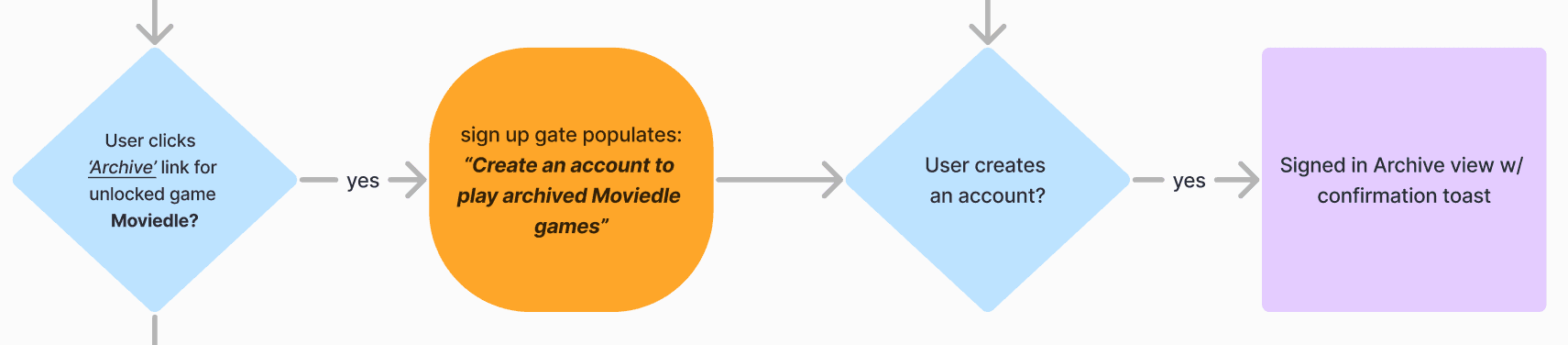
Today’s Moviedle stayed open to everyone. The archive and the locked games carried the account ask, and each gate named what the account got you right then.
One system, worn differently
One system, worn differently
Web carried the existing traffic, so it had to be the full, primary experience, not a stripped-down companion. The app carried the deeper relationship: account benefits, streak history, the rest of Likewise’s recommendation product. Dark mode gave the same components a different personality without changing what they were.


Light, everyday web system on the left; the same Arcade cards re-skinned for dark mode in the app on the right.
Making play shareable
Making play shareable
Sharing was part of the growth thesis from the start: a short daily challenge that ends in a result someone wants to post is a game that travels on its own, without any paid spend behind it.
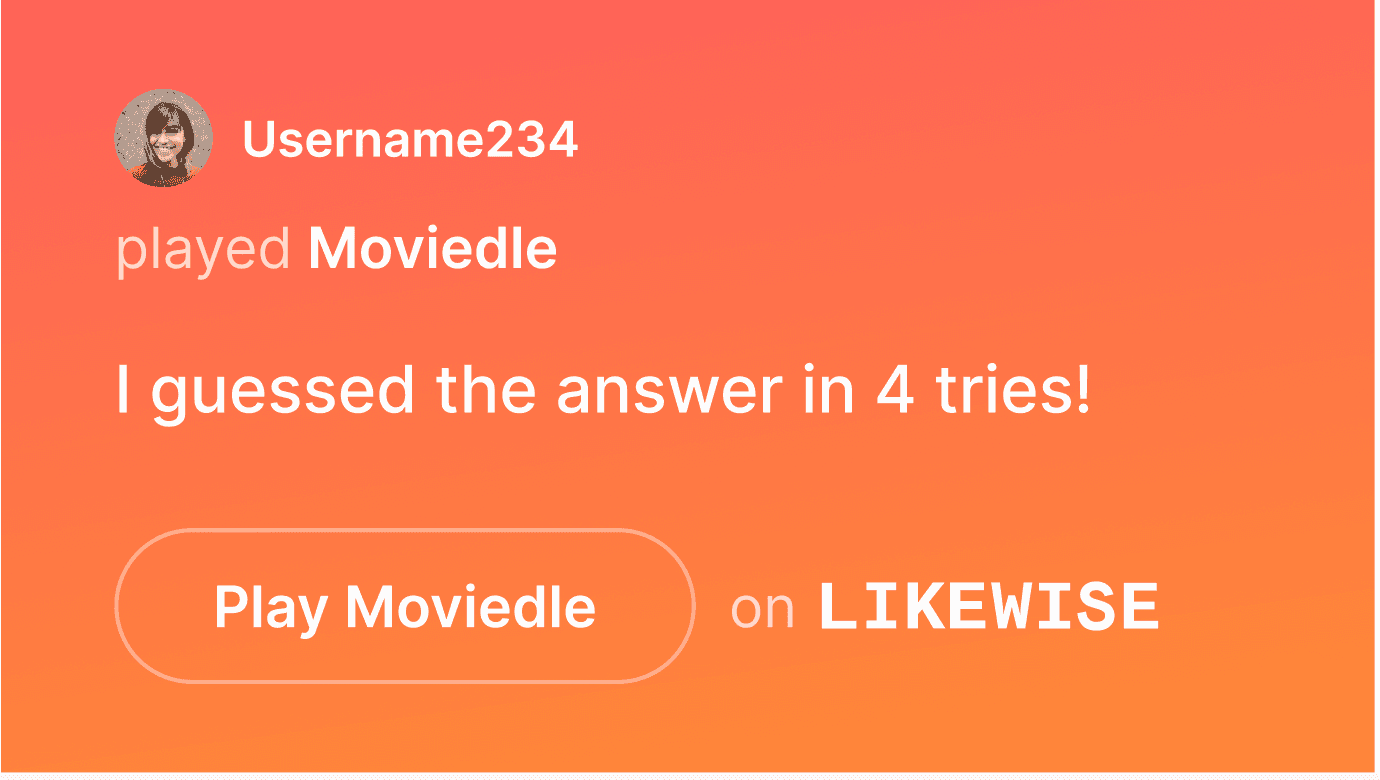
A result worth posting
Finishing a game produced a branded result card: how many tries it took, the game’s name, a link back to play it on Likewise. It was built to be shared the way Wordle’s grid was, without spoiling the answer for anyone who hadn’t played yet.
Outcome
Outcome
Games became the most-trafficked area of the Likewise website.
Arcade became a genuinely high-traffic, organic destination inside Likewise, without a paid acquisition budget behind it. The archive, streaks, and account incentives were our way of pulling some of that traffic into the rest of the ecosystem.
It didn’t solve everything. The games drove traffic. Getting those players to care about the rest of Likewise was the harder, ongoing problem. The archive/account strategy was our answer to it, not a finished solution.
Where Arcade could go next
Where Arcade could go next
As generative AI was taking off, I started asking whether Arcade’s catalog could grow without every game being hand-built: trivia generated by AI around a theme, so we could produce a much bigger, more dynamic set of challenges than a small team could author on its own.

Concept / prototype, not shipped
Reached prototype stage but never built into production. Priorities shifted before it shipped. Included here as a direction, not a result.
Likewise was later acquired, and the company’s strategy shifted toward a newsletter and media model with a much smaller technical footprint. Arcade was scaled back as part of that shift, not because people had stopped playing it.
Reflection
This project was really about designing the product system around the games: discovery, return behavior, and a conversion path that didn’t cost us the habit the game was built on. The most important early decision wasn’t visual. It was recognizing that a loyal audience with a bare-bones product was a bigger opportunity than a polished product with no audience at all.
Layering value instead of gating it is a harder design problem than it sounds. Every ‘no’ to a hard paywall has to be answered with a ‘yes, and here’s what’s better if you stick around.’ Building that second answer, over and over, across a growing suite of games, was the real work.